
Introduction
Choosing the right domain extension is an important step when building a website, and understanding top level domains types helps you make better decisions from the beginning. When you visit a website, you may notice endings like .com, .in, or .org after the name. These endings are called Top-Level Domains, commonly known as TLDs. While they may look small, they play a very important role in how websites are identified and trusted on the internet.
For anyone planning to create a website, understanding top level domains types is important. The TLD you choose can affect your brand image, audience trust, and even search visibility. In India, many businesses and individuals struggle to select the right domain extension because they are unaware of the available options.
This article explains what TLDs are, their different types, and how to choose the right one for your website in a simple and practical way.
What Are Top-Level Domains (TLDs)?
A Top-Level Domain is the last part of a domain name that appears after the dot.
For example:
- In
example.com,.comis the TLD - In
example.in,.inis the TLD
TLDs are managed globally to ensure that every domain name on the internet is unique and organised properly. They help browsers and users understand the nature or location of a website.
Why Are Top-Level Domains Important?
TLDs are not just technical elements. They Affect how users perceive your website.
Top-level domains help with:
- Website identity and branding
- Building trust with visitors
- Targeting specific regions or audiences
- Making domain names easier to classify
Choosing the right TLD is a key step when registering a domain name.
Main Top Level Domains Types Explained
There are several types of TLDs, each created for a specific purpose. Let’s understand them one by one.
Generic Top-Level Domains (gTLDs)
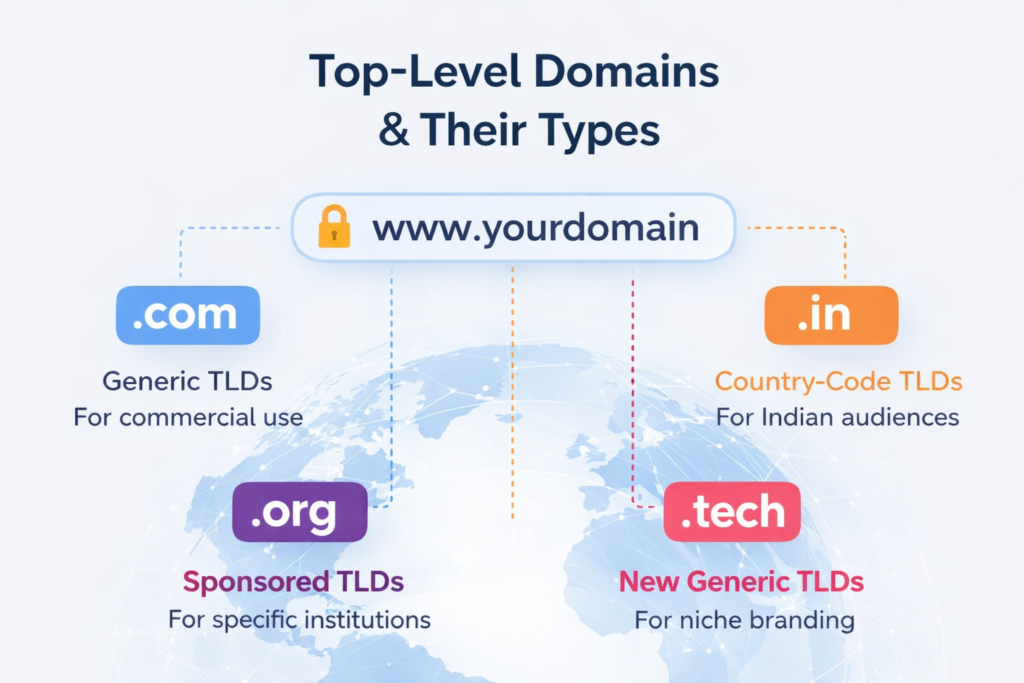
Generic Top-Level Domains are the most commonly used TLDs worldwide. They are not restricted to any country.
Popular gTLD Examples:
.com– Commercial websites.org– Organisations and non-profits.net– Network-related services.info– Informational websites
When to Choose gTLDs:
- If your audience is global
- If you want a professional and trusted extension
- If branding is more important than location
Among all top level domains types, .com remains the most trusted and widely recognised.
Country Code Top-Level Domains (ccTLDs)
Country Code Top-Level Domains are specific to individual countries.
Common ccTLD Examples:
.in– India.uk– United Kingdom.us– United States.au– Australia
Benefits of ccTLDs:
- Builds trust among local users
- Helps target a specific country audience
- Useful for local SEO strategies
For Indian businesses, using .in or .co.in often signals Trust and local presence.
Sponsored Top-Level Domains (sTLDs)
Sponsored TLDs are created for specific communities or purposes and are managed by sponsoring organisations.
Examples of sTLDs:
.edu– Educational institutions.gov– Government websites.mil– Military organisations
These domains are restricted and cannot be registered by the general public.
New Generic Top-Level Domains (New gTLDs)
To meet the growing demand for domain names, many new gTLDs have been introduced.
Examples of New gTLDs:
.tech.online.store.blog.digital
Why New gTLDs Are Gaining Popularity:
- More domain name availability
- Creative branding options
- Suitable for niche businesses
However, they may require stronger branding efforts to build user trust.
Infrastructure Top-Level Domains
This category includes a special TLD used for technical purposes.
Example:
.arpa
This type is mainly used for internet infrastructure and not for regular websites.
How to Choose the Best Domain Extension for Your Website
Choosing the correct TLD depends on your website goals.
Consider These Factors:
- Your target audience (local or global)
- Nature of your website (business, blog, organisation)
- Brand recognition
- Future expansion plans
Quick Selection Tips:
- Use
.comfor universal appeal - Choose
.infor Indian-focused businesses - Select niche TLDs only if they clearly match your brand
Understanding top level domains types helps you avoid mistakes during domain registration.
Common Myths About Top-Level Domains
Many people believe that only .com domains rank on Google. This is not true.
Google treats most TLDs equally when it comes to ranking. What matters more is:
- Quality content
- Website performance
- User experience
TLDs influence trust and branding, not direct rankings.
Top-Level Domains and SEO: What You Should Know
TLDs do not directly boost SEO rankings, but they support SEO indirectly.
They help with:
- Click-through rates
- Local targeting
- Brand recall
For Indian audiences, ccTLDs can help signal regional relevance.
Image Suggestions (SEO-Friendly)
- Image Idea: Diagram showing different types of domain extensions
Alt Text: top level domains types explained with examples - Image Idea: Website address bar highlighting TLDs
Alt Text: top level domains types for website owners
Internal & External Linking Suggestions
- Internal Linking Suggestion:
Link this article to a related post like “What Is a Domain Name and Why Is It Important?” - External Authority Reference:
Mention information from a globally recognised internet domain authority that manages and explains domain extensions worldwide.
Conclusion
Top-Level Domains are a small but powerful part of your website identity. Understanding top level domains types helps you make smarter decisions when registering a domain name. Whether you choose a global extension like .com, a local one like .in, or a niche-based new TLD, the key is alignment with your audience and goals.
Before finalising your domain, take a moment to evaluate how the TLD represents your brand. The right choice can improve trust, clarity, and long-term growth.
A strong website always starts with the right domain foundation.